Foreword
Introduction
Italy
The mosaics of Italy first appeared in the late second century BC under the influence of the Hellenistic Greek pictorial tradition, in which tiny pieces of irregular stone were used to create narrative themes in detailed, colorful compositions that imitated the effects of painting.1 The earliest examples of this type, most of which were emblemata, or picture panels, were either introduced to the region by Greek craftsmen or manufactured elsewhere and imported. Found predominantly in the cities around the Bay of Naples and Rome mosaics in this style, such as the well-known Alexander Mosaic from the House of the Faun at Pompeii and the Nile Mosaic from Palestrina, both dating to about 100 BC, were considered expensive luxury items, reserved exclusively for the decoration of the wealthiest constructions. Smaller emblemata were usually centerpieces of floors, and they were typically surrounded by plain white tesserae or framed by simple decorative patterns. On some later floors, the figural scene was set in a more elaborate design, such as in the House of the Labyrinth at Pompeii, which features an emblema of Theseus and the Minotaur dating to about 70–60 BC and framed by a black-and-white labyrinth pattern.2
By the end of the first century BC, the production of mosaic pavements in various new Roman styles became widespread throughout Italy. The tremendous expansion in the use of mosaics to decorate both public and private buildings resulted in a number of different types that ranged from colorful figural scenes to predominantly black-and-white geometric and floral patterns.3 The Villa of the Volusii Saturnini at Lucus Feroniae, north of Rome, includes both styles: polychrome mosaics in a phase of the villa dated to about 60–50 BC contrasting with black-and-white pavements from the period of about AD 10–20.4 Black-and-white style mosaics, like the Getty’s Mosaic Floor with Head of Medusa (cat. 1), however, became increasingly common by the late first century AD, especially in Rome and central Italy.5 Complex geometric designs, like the intricate pattern of curvilinear triangles encircling the bust of Medusa in this mosaic, now covered the floors of entire rooms. Stylized vegetal motifs, used in similarly themed compositions, such as the detailed floral pattern that surrounds the central head of Medusa in a mosaic decorating the floor of the triclinium in the House of Bacchus and Ariadne at Ostia, were equally prevalent.6 Although this new decorative style may have served as a less expensive solution to the more costly tesserae required for polychrome mosaics, in the second century AD black-and-white patterned mosaics of extremely high quality were also used in the decoration of Hadrian’s Villa at Tivoli and in the Palazzo Imperiale at Ostia.7
The growing popularity of the black-and-white mosaic style in Italy in the first and second centuries AD had a strong impact on mosaic designs outside of Italy, particularly in the Roman provinces of Gaul and North Africa. The introduction and diffusion of this style in these regions in the first century AD can most likely be attributed to the increasing Roman presence in the region; itinerant craftsmen traveled or settled in the area and established workshops for mosaic production. Around the beginning of the fourth century AD, however, provincial workshops exerted a profound influence in Italy, even in Rome itself, bringing a new preference for large-scale scenes of the hunt or the arena to luxurious Italian villas. The Getty’s fourth-century AD Mosaic Floor with Bear Hunt (cat. 2), from a seaside villa near Baiae on the Bay of Naples, exemplifies this new style, which was particularly characteristic of mosaics in North Africa during this period. The North African influence is also evident in the Great Hunt mosaic at Piazza Armerina in Sicily and in a hunting mosaic from the Gardens of Licinius on the Esquiline Hill in Rome, both dating to the early fourth century AD, which in turn derive from the third-century AD hunting mosaics, such as those from Carthage, Thysdrus (present-day El Djem), and the Villa of the Laberii at Oudna.8
- This technique, known as opus vermiculatum, appeared as early as the third century BC in Sicily and then spread north throughout Italy. On the origins of these types of pavements, see the discussion in Phillips 1960, 243–62. For a general history of mosaics in Sicily, see von Boeselager 1983. ↩
- Strocka 1991. ↩
- The earliest black-and-white ornamental mosaics often imitated other types of pavements in motif and composition, and they may have been used as a substitute for the more expensive polychrome mosaics. ↩
- Moretti and Sgubini Moretti 1977, plates 35–36, 39–42. The new preferences that begin to appear in mosaics about 20 BC also parallel changes in taste in wall painting: polychromy and three-dimensional decorative motifs disappear and are replaced by flat black-and-white designs and figural styles; see Clarke 1991, 61–63. ↩
- On the relationship between the development of black-and-white style mosaics and the architectural spaces they decorated, see Clarke 1979. ↩
- House of Bacchus and Ariadne: Clarke 1979, fig. 20. ↩
- Hadrian’s Villa at Tivoli: Blake 1936, plates 11–14. Palazzo Imperiale at Ostia: Becatti 1961, plates 24, no. 300, and 69, no. 296. Ostia, the port of Rome, provides the most extensive evidence for the development of mosaic pavement types following the destruction of Pompeii and Herculaneum by the eruption of Vesuvius in AD 79; many examples date to the second and early third centuries AD. The vast majority of these are black-and-white figural mosaics, often with marine subjects, as in the Baths of Neptune (Clarke 1979, figs. 31–34) and the Baths of the Lighthouse (Clarke 1979, figs. 69–71). ↩
- Piazza Armerina: Gentili 1954, 33, fig. 14 (Small Hunt), 36, figs. 17–21 (Corridor of the Hunt); Gentili 1959, figs. 4, 5 (drawings); and Lavin 1963, 244–51, figs. 8, 9 (Corridor of the Hunt), fig. 110 (Small Hunt). Esquiline: Aymard 1937, 42–66, plates 1–3; Lavin 1963, 258, figs. 122–23; and Cima 1998, fig. 9. The Esquiline mosaic is now in the Musei Capitolini Centrale Montemartini (inv. no. AntCom03636). Thysdrus: Gauckler 1910, 26, no. 64; and Lavin 1963, fig. 80. Carthage: Poinssot and Lantier 1923, 154–58; and Lavin 1963, fig. 79. Oudna: Gauckler 1910, 122–23, no. 362; and Lavin 1963, 230–31, fig. 75. ↩
Mosaic Floor with Head of Medusa
Provenance
This mosaic originally decorated the floor of a Roman villa in one of two adjacent rooms, both with similar mosaics, discovered on the Via Emanuele Filiberto in Rome. The site was excavated by Angelo Pasqui in 1910, but it is uncertain when the mosaic was removed.1 It was purchased by the J. Paul Getty Museum in 1971.2
Commentary
A colorful female bust is the only polychrome feature in this otherwise black-and-white mosaic. Snakes around her neck and serpentine locks of hair identify her as the Gorgon Medusa. The image decorates the central medallion of the mosaic, with the face turned upward and to the right. An elaborate geometric pattern encircles the bust: concentric bands of alternating black-and-white triangles decrease in size as they spiral toward the center, creating the optical illusion of spinning motion. The design has also been interpreted as a shield of scales, a reference to the aegis worn by Athena, a scaly mantle decorated with the head of Medusa. A guilloche border around the circle is enclosed within a second, square guilloche that outlines the entire composition. Kantharoi fill the triangular spaces at each of the four corners.
In Greek mythology, the Gorgon Medusa was a fearsome monster who turned viewers to stone with her gaze. When she was finally killed—beheaded by the hero Perseus—her hideous head was presented to his patron goddess, Athena. The Gorgon head was a popular apotropaic device in Greek art, as its terrifying appearance was believed to ward off evil. In Roman art, however, Medusa was humanized and more clearly female; at times she was even depicted in the form of a beautiful woman. During the Roman period, the image of the Gorgon often served a primarily decorative function in interior decoration, appearing, for example, on domestic utensils and wall paintings, but it continued to be regarded as a protective symbol. Representations of Medusa were often accompanied by imagery related to the god of wine, Dionysos, whose worship invoked pleasure and good fortune. The kantharoi found in the corners of the Getty mosaic are closely associated with the revelries of Dionysos. A Roman mosaic from “Kisamos,”, on Crete, similarly depicts the central bust of Medusa surrounded by panels of masks and followers of Dionysos.3 An explicit connection appears in a late second-century AD mosaic pavement from a Roman villa at Corinth, which features the head of Dionysos at the center of the same pattern found on the Getty mosaic and a guilloche border with kantharoi in the corners.4
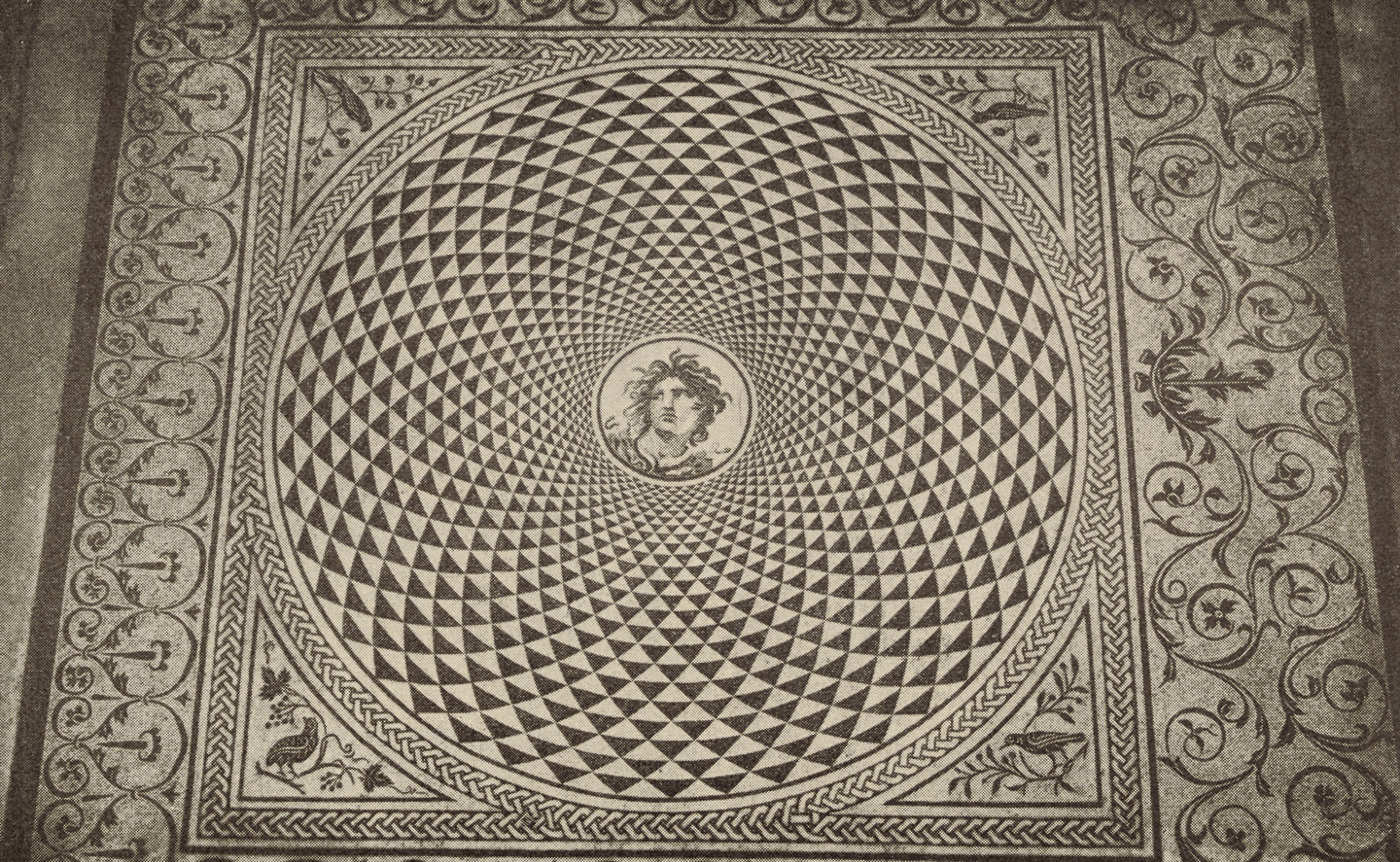
Figure 1. Mosaic with Head of Medusa, Roman, AD 115–150. Found in Rome, Italy, 1910. Stone tesserae, 530 × 450 cm. Museo Nazionale Romano—Palazzo Massimo alle Terme, 56253
The Getty’s Medusa mosaic originally decorated a small room measuring 3.6 × 2.9 meters. A pendant mosaic (fig. 1) survives from an adjacent, larger room (5.3 × 4.5 meters) of the same villa; it was most likely made by the same workshop and is now in the collection of the Museo Nazionale Romano—Palazzo Massimo alle Terme.5 This second mosaic depicts the bust of Medusa in mirror image, her gaze turned upward to the left. Her head is also placed at the center of a black-and-white shield or spinning wheel design. Birds perch on branches in the four corners instead of kantharoi, and a pattern of stylized tendrils and ornate scrolls frames the guilloche border. The excavation of this villa revealed that the two rooms originally formed one large rectangular chamber decorated with a black-and-white mosaic of a marine scene before it was subdivided and redecorated with the pair of Medusa mosaics.6 Although the reason for the renovation or reconstruction of the villa is unknown, the construction of the building in opus mixtum, a technique used especially during the rule of the emperor Hadrian from AD 117 to 138, indicates that the transformation likely took place sometime in the early second century AD.7 The style of the mosaics is typical of private villas in Italy during this period, which were decorated predominately with black-and-white mosaics made up of complicated, often curvilinear geometric patterns and highly stylized floral designs.
Comparanda
The circular geometric design with the Gorgon head at its center was used frequently on mosaic pavements throughout the Roman Empire. Many were colorful, polychrome compositions. In second-century AD mosaics from Piraeus in Greece and Pergamon in Asia Minor (present-day Turkey), the triangles of the scale pattern are rendered in shades of red, blue, green, and yellow, with a guilloche border in yellow and blue.8 The example from Pergamon, like the Getty mosaic, also displays kantharoi in its four corners. In a variation on the spinning aspect of the design, the curvilinear triangles encircling the head of Medusa in a late second-century AD mosaic floor from the House of the Red Pavement at Antioch form concentric petal shapes.9 Scale patterns could also be composed of shapes other than triangles. A mosaic from the *triclinium of a Roman villa at Marcianopolis in Thrace (present-day Devnya, in Bulgaria), known as the House of Antiope, displays Medusa within a circular pattern of spade-shaped scales surrounded by a meander pattern, with felines in each of the corners.10 Comparable examples from North Africa include a Roman villa at Thysdrus (present-day El Djem) and a bath complex at Dar Zmela, both characterized by a similar pattern of spade-shaped scales and flower motifs in the corners, as well as the Great Baths at Thaenae, (present-day Thina), decorated with radiating waves of alternating colors.11 An unusual version of this design in opus sectile was discovered at in southern Turkey, where it covered the floor of the orchestra of an odeion or bouleuterion that was destroyed in the fifth or sixth century AD.12 Although other examples of the shield or spinning wheel motif appear in opus sectile, all feature a geometric pattern in place of the head of Medusa. One of these, executed in polychrome marble, was found in the Villa dei Papiri at Herculaneum, the famous Roman villa that inspired the design and decoration of the Getty Villa in Malibu.13
Condition
The central medallion is largely intact, but the edges, including the two vessels in the lower half of the mosaic and much of the border, appear to be modern reconstructions. Reportedly, the mosaic was already badly damaged when it was discovered.
Bibliography
Pasqui 1911, 338–39; Blake 1936, 83; Vermeule and Neuerburg 1973, 51–52, no. 111; Hessenbruch McKeon 1983, 239–41, cat. no. 23; Aisenberg 1994, plate 10; J. Paul Getty Museum 2010, 220.
- For the excavations of the villa, see Pasqui 1911, 338–39. It seems that the mosaic may have been reburied and lifted later. Period photographs in the Getty curatorial files, including one labeled “Casa dei Neroni,” show the mosaic as the floor of a modern house, but the location and previous owner have not yet been identified. ↩
- Purchased from the Royal Athena Galleries, New York. ↩
- Markoulaki 1987, plate 324 (detail only), early third century AD. Another Medusa mosaic, from the Villa of Dionysos at Knossos on Crete, depicts heads representing the four seasons in the corners; see Paton 2000, 553–62. ↩
- Shear 1930, plate 10 (now in the Archaeological Museum of Ancient Corinth, inv. no. A609 / MOS 25–3). ↩
- Museo Nazionale Romano, Rome, inv. no. 56253; Paribeni 1913, plate 1; and Aurigemma 1974, plate 104. In Hessenbruch McKeon 1983, 238–39, cat. no. 22, the author writes that at the time of publication the tondo was in the Ministero Archeologico di Roma. It is currently in the Museo Nazionale Romano—Palazzo Massimo alle Terme. No architectural plan or description of the layout of the building was published at the time the mosaic was excavated. ↩
- See Pasqui 1911, 338, with figures of sea monsters and dolphins led by winged putti and Tritons. ↩
- See Pasqui 1911, 338, which identifies the remains of a building made in opus mixtum. ↩
- Piraeus (now in the National Archaeological Museum of Athens): Philadelpheus 1894, plate 4. Pergamon (now in the Bergama Archaeological Museum, Izmir): Scheibelreiter-Gail 2011, 338–39, no. 107, and 649, fig. 484. Additional information can be found in Hessenbruch McKeon 1983, 264–67, nos. 43 and 45. ↩
- Levi 1947, plate 14a (now in the Princeton University Art Museum, inv. no. y1965-212). ↩
- Minchev 2002, 253, figs. 4, 5. The mosaic remains in situ in the Museum of Mosaics, Devnya (Bulgaria), which was constructed on top of a late third- to early fourth-century AD Roman villa, the so-called House of Antiope. ↩
- El Djem: Merlin 1915, no. 71f, no. 2; Foucher 1963, 97, fig. 13b; Dunbabin 1978, 163 and 258 (catalogue). Dar Zmela: Foucher 1960b, 121–22, no. 57.247; Foucher 1963, 97, fig. 13a; and Dunbabin 1978, 163 and 271 (catalogue). The design is meant to represent a shield, but it is not contained within a circular frame. Thina: Gauckler 1910, no. 18, A, 14; and Dunbabin 1978, 163 and 273 (catalogue). Additional bibliography can be found in Hessenbruch McKeon 1983, 301–2, nos. 64, 71, 72. Dunbabin 1978 dates the mosaics from El Djem and Thina to the late third century AD and the mosaic from Dar Zmela to the second half of the second to early third century AD, identifying Medusa as an apotropaion. ↩
- Özüdoğru and Dökü 2010, 39–42, figs. 5, 6; and Özüdoğru and Dökü 2012, 51. ↩
- Spinazzola 1928, plate 195, now in the Museo Archeologico Nazionale, Naples. ↩
Mosaic Floor with Bear Hunt
Provenance
This mosaic was acquired by the J. Paul Getty Museum in 1972 from Jeannette Brun, a Zurich-based antiquities dealer, who reported that it had been in an Italian collection but provided no further information regarding its provenance. Subsequent publications attributed the work on stylistic grounds to a North African atelier.1 Recent archival research, however, indicates that the mosaic was in fact unearthed in June 1901, in a vineyard in the vicinity of Lago di Lucrino, north of Baiae and just west of Naples.2 At the time of its discovery, architects and archaeologists at the Museo Archeologico Nazionale in Naples suggested that the mosaic may have decorated the great room of a bath but believed it had little artistic value and recommended against its acquisition by the museum.3 Subsequently, the Italian state authorized the landowner, Schiano Muriello, to sell the mosaic, and it was purchased in March 1906 by Ernesto Osta, a lawyer who intended to use it in the decoration of the monument to King Vittorio Emanuele II in Rome. The mosaic was lifted from the ground, but portions of it remained in situ owing to its poor condition and the difficulty of removing it intact. The lifted mosaic remained in storage in Naples, and in 1925 it was offered to John Marshall, a British art expert and dealer in Rome. By 1929, Osta’s heirs sold it to Rodolfo Follis of Turin. Follis sought ministerial permission to export the mosaic, but the legality of his ownership was questioned.4 Precisely when the mosaic left Italy is unknown. Four other panels from the mosaic (figs. 2–5), which had been clandestinely removed from the site and eventually recovered by Italian authorities, are now in the Museo Archeologico Nazionale in Naples.


Commentary
The center of the preserved portion of the mosaic depicts a bear hunt. From the left, three hunters wearing high boots, long-sleeved tunics, and short, belted garments draped diagonally from the left shoulder drive five bears into a large, semicircular net tied to a pair of trees. A fourth hunter appears on a panel now in the Museo Archeologico Nazionale in Naples (fig. 5).5 His outstretched left arm continues onto the left side of the Getty’s part of the mosaic (fig. 6). The others stand in similar poses, with legs bent and arms extended forward. Three hold staffs in their right hands; three are beardless. Two of the figures are accompanied by inscriptions identifying them as Lucius and Minus. A cord in Minus’s left hand suggests that he is tying the net to a tree. The bears, like the hunters, move to the right across different levels of ground. All the bears have open mouths, and two have turned their heads back to the hunters, as if to snarl at them. In addition to the two tall trees that frame the scene, other, abbreviated landscape elements include darker tesserae representing the ground in the lower level and some small plants and clumps of grass above. Cursory shadows are also depicted, as are highlights and shading.
The figural scene is bordered by a colorful double guilloche consisting of green, yellow, white, red, and black tesserae. Outside the guilloche, at right, is a long, straight, vertical laurel festoon tied at center by a ribbon. A third, outermost border consists of an exuberant acanthus rinceau inhabited by fruit, armed cupids, and the protomes of real and imaginary animals, including a horse, a panther, and a griffin. The two preserved corners are adorned with large acanthus-enveloped faces (fig. 7), rather like personifications of the Seasons but undifferentiated. On one of the four panels in Naples, a third, smaller face emerges from the acanthus rinceau (fig. 2). This face was likely located beneath and to the left of the hunters, and its almost fully frontal orientation suggests that it may have originally marked the midpoint of the entire mosaic, which must have included at least one additional scene; for while the right side of the bear hunt terminates in a tree and the vertical festoon beyond the double guilloche border, the left side evidently continued beyond the tree between Minus and Lucius. Other large hunt mosaics of the period, such as that from the Gardens of Licinius on the Esquiline Hill in Rome, also include the netting of animals as part of more complex compositions consisting of several different scenes.6
Numerous ancient literary sources note the aristocratic taste for venationes. The emperor Hadrian, who ruled from AD 117 to 138, is reported to have hunted bears in both Greece and Asia Minor, and he is depicted hunting on horseback in a roundel on the Arch of Constantine in Rome. The emperor even composed a poem, later inscribed in stone, celebrating his success as a hunter. Bears were found throughout the ancient Mediterranean world, however, and were captured to be trained as well as slaughtered. The second-century AD treatise on hunting, Cynegetica, by Pseudo-Oppian, describes in detail one method of netting bears (although not the manner depicted in the Getty mosaic): driving them along a rope hung with colored ribbons and feathers. The letters of the late fourth-century AD consul Symmachus, among other sources, relate efforts to procure bears and various beasts for public entertainment.7 Klaus Werner, who first recognized the Campanian origins of the Getty mosaic, and Maddalena Cima have argued that this theme was a particular favorite of emperors who sponsored spectacles with wild animals in the amphitheater.8
The findspot of the Getty Bear Hunt mosaic has yet to be fully investigated. It was discovered with a marble border and fragments of columns near the so-called Stufe di Nerone, in the Scalandrone neighborhood north of Baiae. These monumental architectural remains have been damaged by the construction of modern streets and overbuilding and, consequently, are not well understood.9 The early twentieth-century archaeologists who saw the Getty mosaic in situ made additional soundings and estimated its full length to be at least twelve meters.10 The unusual shape of the mosaic, with extended corners, suggests that it may have occupied a space between two more or less oval rooms, such as those used for baths or audience halls.11 The determination that this mosaic once decorated a rich senatorial villa or an imperial residence must await further investigation.
Comparanda
Scenes of hunters forcing bears and other animals into nets and traps are depicted on mosaics throughout the Roman Empire, including examples from Carthage, El Kef, Hippo Regius and Utica in North Africa; Centcelles in Spain; Villelaure in France; and Rome (including one from the Esquiline Hill, noted above) and Ravenna in Italy.12 In 1973, Norman Neuerburg suggested a North African origin for the Getty mosaic, although he also noted comparanda for its iconography in mosaics from the city of Rome and elsewhere in Italy.13 A decade later, David H. Ball published the mosaic, believing it to be of Tunisian origin and attributing it to a Carthaginian workshop. He proposed that it depicted bears being captured for display in the amphitheater, and he was particularly interested in the artists’ treatment of space and the possible source of the imagery, which, he believed, derived from illustrated texts of Pseudo-Oppian’s Cynegetica.14 At about the same time as Ball’s study, Mario Pagano also published the mosaic, not knowing that the majority of it had been acquired by the J. Paul Getty Museum.15 Working from early reports, archival documents (including a now-lost watercolor), and the four panels in Naples, Pagano compared its composition to that of two mosaics in Sicily—the small hunt mosaic at the imperial villa at Piazza Armerina and another from the Villa del Tellaro, near Heloros, —as well as to others in North Africa. He also cited parallels for the populated acanthus rinceau of the border on mosaics in Antioch (Turkey) and Argos (Greece). The signature of the mosaicist T. Senius Felix from Puteoli (present-day Pozzuoli, near Naples) on a large mosaic found at Lillebonne in Gaul, dating to the late third or early fourth century AD, suggests that Puteoli was home to workshops that drew upon designs of North African mosaics to decorate the many splendid villas overlooking the Bay of Naples that belonged to rich senatorial clients.16
Condition
The mosaic has been divided into multiple sections, all of which are backed with concrete. Twenty-three panels are in the J. Paul Getty Museum, and four are in the Museo Archeologico Nazionale in Naples. When the Getty panels were first lifted, in 1906 (a date confirmed by scraps of Italian newspaper still attached to two of them), they were backed with concrete reinforced by iron rebar. Correspondence between Jeannette Brun and Getty Museum officials in the early 1970s indicates that restoration of the panels was a condition of the purchase. The restoration was completed in Zurich by mid-June 1972 with considerable difficulty because of the size and number of panels. The concrete backings were reinforced with additional rebar, which in some cases doubled the thickness of the panels. When the mosaic arrived in Los Angeles, museum officials complained to Brun about several aspects of this treatment, especially the lack of alignment among the panels.17 The panels also seem to have been polished smooth prior to the mosaic’s arrival. The mortar between the tesserae of one of the corner panels depicting a face enveloped in acanthus (fig. 7) was subsequently partially removed.
Bibliography
Gabrici 1901; Vermeule and Neuerburg 1973, 53–54, no. 113; Boriello and D’Ambrosio 1979, 44, no. 12, fig. 33; Pagano 1983–84, 179–87, figs. 28–33; Ball 1984; Werner 1994, 293; Cima 1998, 436–38, fig. 8; Lapatin 2014; Pisapia 2014.
- Vermeule and Neuerburg 1973, 53; and Ball 1984. ↩
- Gabrici 1901. See also Boriello and D’Ambrosio 1979, 44; Pagano 1983–84, 179; Werner 1994, 293; Cima 1998, 436–38; and Pisapia 2014. ↩
- Gabrici 1901; and Pisapia 2014. ↩
- Pagano 1983–84, 179–80; and Pisapia 2014. The John Marshall Archive, British School at Rome, id.no.642 (Marshall’s card file B.IV.21). ↩
- Museo Archeologico Nazionale, Naples, inv. no. 11477. ↩
- Lavin 1963; Toynbee 1973; and Cima 1998. ↩
- IG VII 1828; Scriptores Historiae Augustae, Hadrian 20.13; Dio Cassius, Historia Romana 69.10.2. ↩
- Werner 1994, 292–93; and Cima 1998, 436–38. ↩
- Gabrici 1901; Pagano 1983–84, 179n66; and Pisapia 2014, 113–14. No architectural plan or description of the layout of the building was published at the time the mosaic was unearthed. ↩
- Gabrici 1901. ↩
- Vermeule and Neuerburg 1973, 54. ↩
- Lavin 1963; and Toynbee 1973, 93–100. ↩
- Neuerburg mentions festoons in North Africa, subjects of bear (and other animal) driving in Rome, and peopled scrolls in all regions; see Vermeule and Neuerburg 1973, 53–54. ↩
- Ball 1984. ↩
- When Pagano published the mosaic, he believed it had been lost, known only from records. It seems that for a time both scholars were working independently on the mosaic, unaware that it was the same object. ↩
- Pagano 1983–84, 179–87. ↩
- Correspondence in the files of the antiquities department of the J. Paul Getty Museum; Lapatin 2014. ↩
Gaul
The province of Gallia Narbonensis, in the southern part of Gaul (present-day France), was one of the earliest regions of the Roman Empire to be affected by Greek and Roman culture. Even before the Roman conquest of the late second century BC, there was a significant Greek presence in the region, notably at Massalia (present-day Marseille), a Greek colony founded about 600 BC. The earliest examples of mosaics and other decorated floors in Gaul, dating to the first century BC, are found in this region, beginning with simple types related to the Italian opus signinum and terrazzo. Mosaics composed of tesserae became more prevalent in the late first and early second centuries AD, and it is likely that the technique was introduced by itinerant craftsmen, who established workshops in the region. The development of mosaic styles that followed this early period—specifically, the appearance of the black-and-white style mosaics that were widespread in Italy—reflects the rapidly expanding Roman presence in the region. Local craftsmen soon integrated their own designs and compositions, however, resulting in the distinctive Gallo-Roman style that was characteristic of the workshops operating in the Rhône valley.
The earliest mosaics of this Gallo-Roman type date to the middle of the second century AD. At that time, the main centers of mosaic production in Gaul were located in the upper Rhône valley at Lugdunum (present-day Lyon) and around Vienne, especially in its suburbs of Saint-Romain-en-Gal, and Sainte-Colombe, where workshops are thought to have continued production through the early third century AD. These workshops developed the so-called multiple decor design, with individual figures or scenes isolated in an elaborate grid-like framework resembling a coffered ceiling.1 The emblema of the Getty mosaic of Orpheus and the Animals (cat. 3) exemplifies the Gallic multiple decor style, with different figures from the myth of Orpheus inhabiting adjoining hexagons. Notably, however, the surrounding field of black-and-white geometric patterns continues to reflect the influence of Italian traditions (see fig. 8) for the mosaic with its complete border). Another mosaic, also from Vienne, with a central panel depicting the drunkenness of Herakles, displays a more developed form of multiple decor composition. The main scene is surrounded by square panels containing an extraordinary variety of designs that draw upon the extensive decorative repertory of the Rhône workshops.2 In addition to standard mythological subjects, scenes of contemporary Roman life are also characteristic of mosaics in the upper Rhône valley. A number of mosaics depict episodes from daily life, such as farming and hunting, as well as chariot races and other spectacles from the arena.3 Representations of these activities were adapted to the multiple decor design by filling in the compartments with figural groups, often acting in a series of related events.
While the main production centers in Gaul were in the upper Rhône valley, an active mosaic culture, dependent primarily on the workshops of Aix-en-Provence,also existed in the cities farther south.4 The surviving evidence suggests that a more conservative stylistic tradition developed in the south; significantly, the multiple decor style is relatively infrequent there. A mosaic from the rue des Magnans in Aix-en-Provence is a notable exception, in which panels with various geometric patterns surround a scene of the boxing match between Dares and Entellus—the same image depicted on the Getty mosaic (cat. 4).5 The majority of the Aix-en-Provence mosaics, however, are monochrome pavements consisting of white floors outlined by simple black borders. Although fewer in number, examples of black-and-white geometric designs were also seen in this period, reflecting the Italian influence in this part of Gaul as well.6 A few mosaics from this area, found almost exclusively in wealthy villas, include colorful central panels with detailed figural scenes.7
While many mosaics from the upper Rhône valley depict scenes of Roman life, examples from Aix-en-Provence and its vicinity usually illustrate subjects from mythology or literature. Certain themes used in the mosaics from this area are highly original. The combat between Dares and Entellus depicted on the Getty mosaic is an episode from Virgil’s Aeneid (5.362–482) that is relatively unknown outside of southern Gaul.8 Likewise, a second mosaic from the same villa, now in the Los Angeles County Museum of Art, represents a specific scene from Ovid’s Metamorphoses (2.401–530)—Diana discovering the pregnant Callisto—that has no counterpart in known Roman mosaics.9 Both mosaics represent distinctly Roman versions of mythology, and their uncommon themes may indicate local preferences associated with this particular area of Gaul.10
- For a general discussion of the features of the Gallo-Roman style, see Lancha 1981, 14–16 (with inventory numbers) and a summary in Dunbabin 1999, 74–78. In addition to the multiple decor style, Lancha identifies two additional characteristics: the use of elaborate floral and vegetal elements, and the use of figural scenes and motifs not present in previous Gallic mosaics. ↩
- Lancha 1981, 106–16, no. 306, plates 40–44, dates the mosaic (now in the Museé de la Civilisation Gallo-Romaine, Lyon) to the last quarter of the second century AD. ↩
- Lancha 1981, 15–16, lists statistics for common mythological themes, such as Orpheus, Dionysos, Herakles, the Seasons, and the Muses. For examples of farming scenes, see Lancha 1981, 208–25, no. 368, plates 107–23. For chariot races, see Lafaye 1909, nos. 712, 785, 1236. For events from the amphitheater, see Lafaye 1909, nos. 1072, 1295, 1611. ↩
- Aix has the greatest number of preserved mosaics in Gaul after Lugdunum and Vienne; see Lavagne 2000, 13–14: Aix (129 mosaics), Lyon (156 mosaics), Vienne, Saint-Romain-en-Gal (212 mosaics). ↩
- Lavagne 1994, 203–15, dated to the mid-second century AD. The pavement lacks anything like the floral designs or the small figural motifs incorporated into examples from Vienne. Regarding the relationship between the rue des Magnans decoration and Vienne, Henri Lavagne asserts that the rue des Magnans mosaic anticipates the multiple decor style that is fully developed in the Vienne workshops; see Lavagne 2000, 17. ↩
- Lavagne 2000, 13–14, provides fifty-five examples of monochrome pavements and fourteen examples of black-and-white designs. Despite the high proportion of monochrome mosaic pavements in the region, expensive pavements in opus sectile were the preferred form of decoration in the numerous luxury Roman villas in this area. Lavagne notes six examples in Aix that, according to him, were made by an Italian workshop, and fifty-five examples total from southeastern Gaul; see Lavagne 2000, 13–14. ↩
- Lavagne 2000, 13–14, records fourteen examples with figures, all from Aix. ↩
- Examples of the Dares and Entellus mosaic in Gaul are discussed in cat. 4, in the present volume. ↩
- Lavagne discusses the scene in the Diana and Callisto mosaic, citing two examples from wall paintings in Pompeii: the House of the Tragic Poet (VI, 8, 3.5) and the House of the Hanging Balcony (VII, 12, 26–27); see Lavagne 2000, 313, no. 916. ↩
- The mosaics from Villelaure (approx. twenty miles north of the modern town of Aix-en-Provence) were likely produced by the workshops of Aix-en-Provence. The early history of the discovery and excavation of the nearby site is summarized in “Villelaure: History of the Excavations,” in the present volume. ↩